

My Safari Packing List for a Baby and Toddler
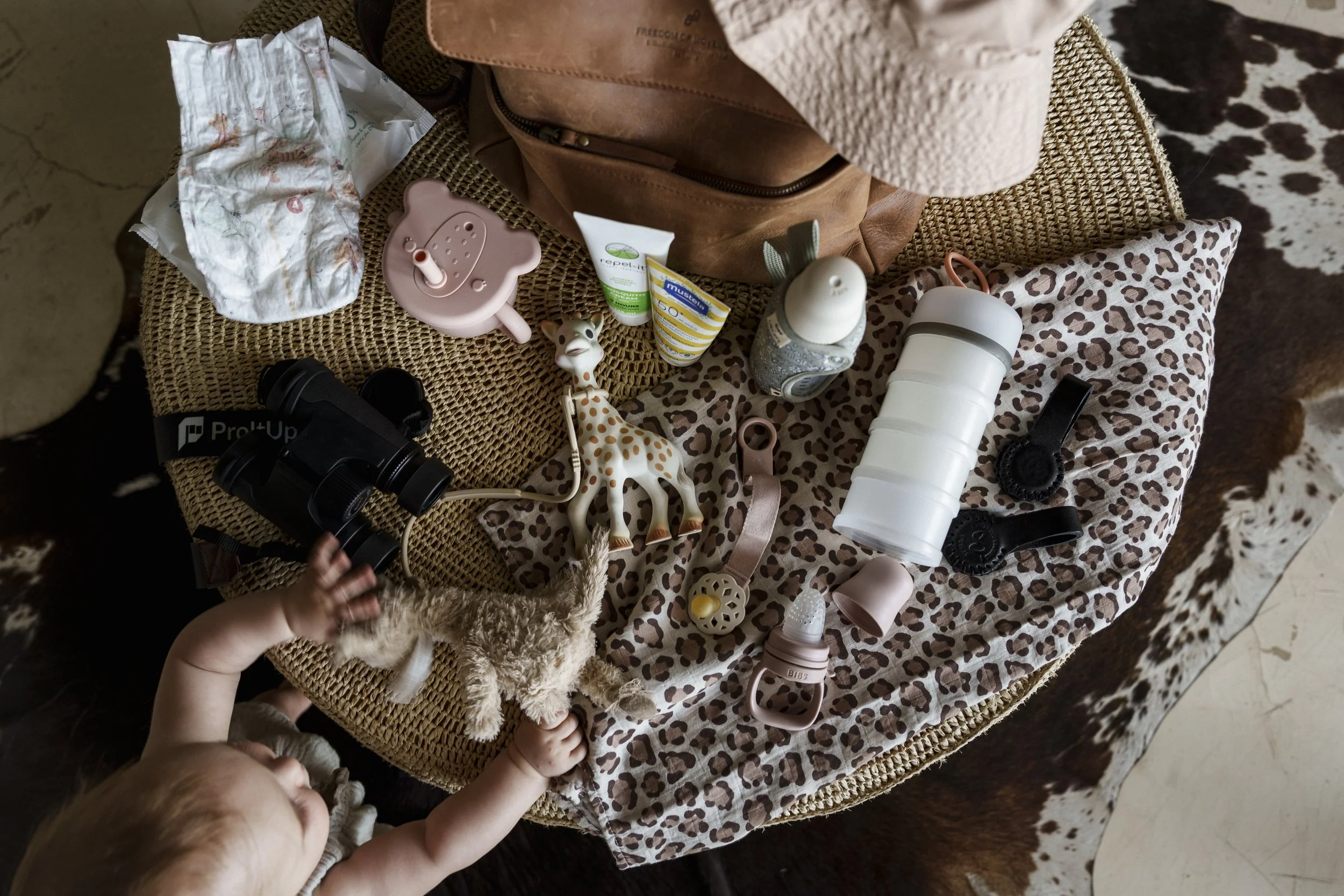
As a first time parent, packing to go on holiday was daunting. Not to mention travelling to a remote destination where the lodge probably doesn't carry nappies in their curio shop. Trying to fit all our katundu, a word used across this part of the world for ‘a lot of stuff’, into a softshell bag and keeping it under twenty kilos, the anxiety was real. My list ticking went back and forth. "Do we need this?" "Do you think the lodge will have back up?" "How many nappies is too many?"
Luckily, one trip turned into almost every month of Bradley’s life, and that overwhelming feeling of what to pack is now muscle memory.
What you'll read below is my safari packing list, from baby through to toddlerhood. The needs change, and luckily so does the amount of stuff you need to pack. Lodges we book for families understand families, and most of them will accommodate a parent's needs. It's the list I wish someone had given me.
What Camp Solves Before You Pack Anything
As a mum who loves dressing her child in the most safari chic clothes, I quickly realised I didn't need an outfit for every occasion. Sure, she's got her beiges, her neutrals and the cute jackets, but I learnt how to turn her wardrobe into a staple one.
Why? Because the best gift a lodge gives a parent is a laundry service.
She now has her safari basics, and those cute jackets, and when they get dirty they go out and come back the next day. Daily laundry is standard at the lodges we book. Some include it, some charge for it, and we'll tell you which is which before you book so it isn't a surprise on your bill.
That's half our luggage problem solved.
The most dreamy part? Not having to carry a camp cot. A fully made up cot with fresh linen, extra blankets and a mozzie net is part of the deal at every property we place families in, because we confirm it before you arrive rather than hope. And my favourite part, the little turndown every evening. It's the details that make us love placing you in the lodges we do.
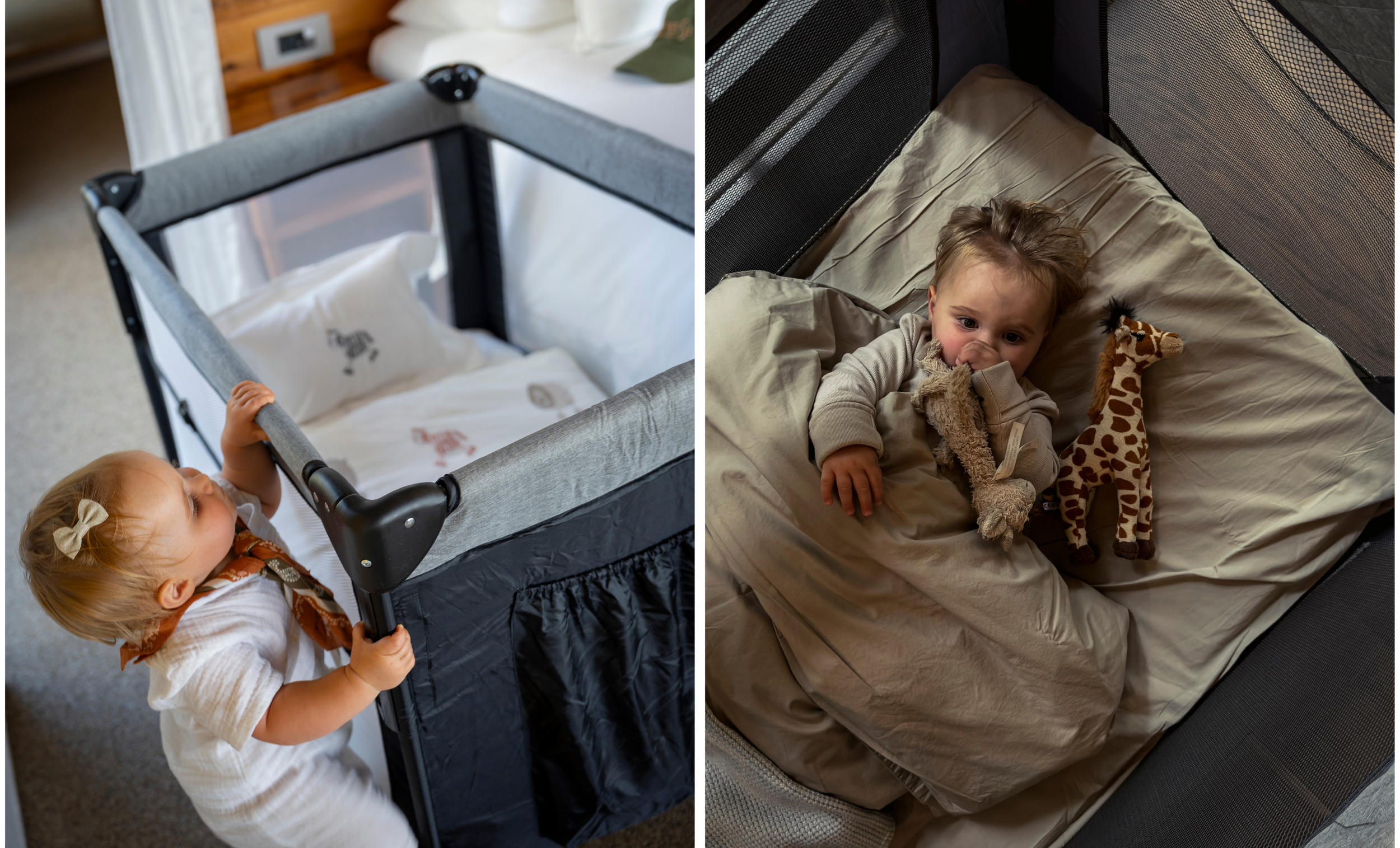
Meal times, high chairs are supplied.
Bottles are easier than you'd think. Every room comes with a kettle, so sterilising in your own room with purified water is always an option, and that's the route we used most often because I could see it being done properly. If you'd rather not, leave them with the kitchen staff and they come back cleaned and dried the same day.
The lodges we book will go out of their way to make sure you have what you need as a parent. During our booking process we ask all the questions around your child's age so that everything is on the ground before you land. That's our part. The lodges do theirs beautifully.
What You're Allowed to Carry
Light aircraft are small and the holds are smaller. The limits are real, and they aren't negotiable at the desk.
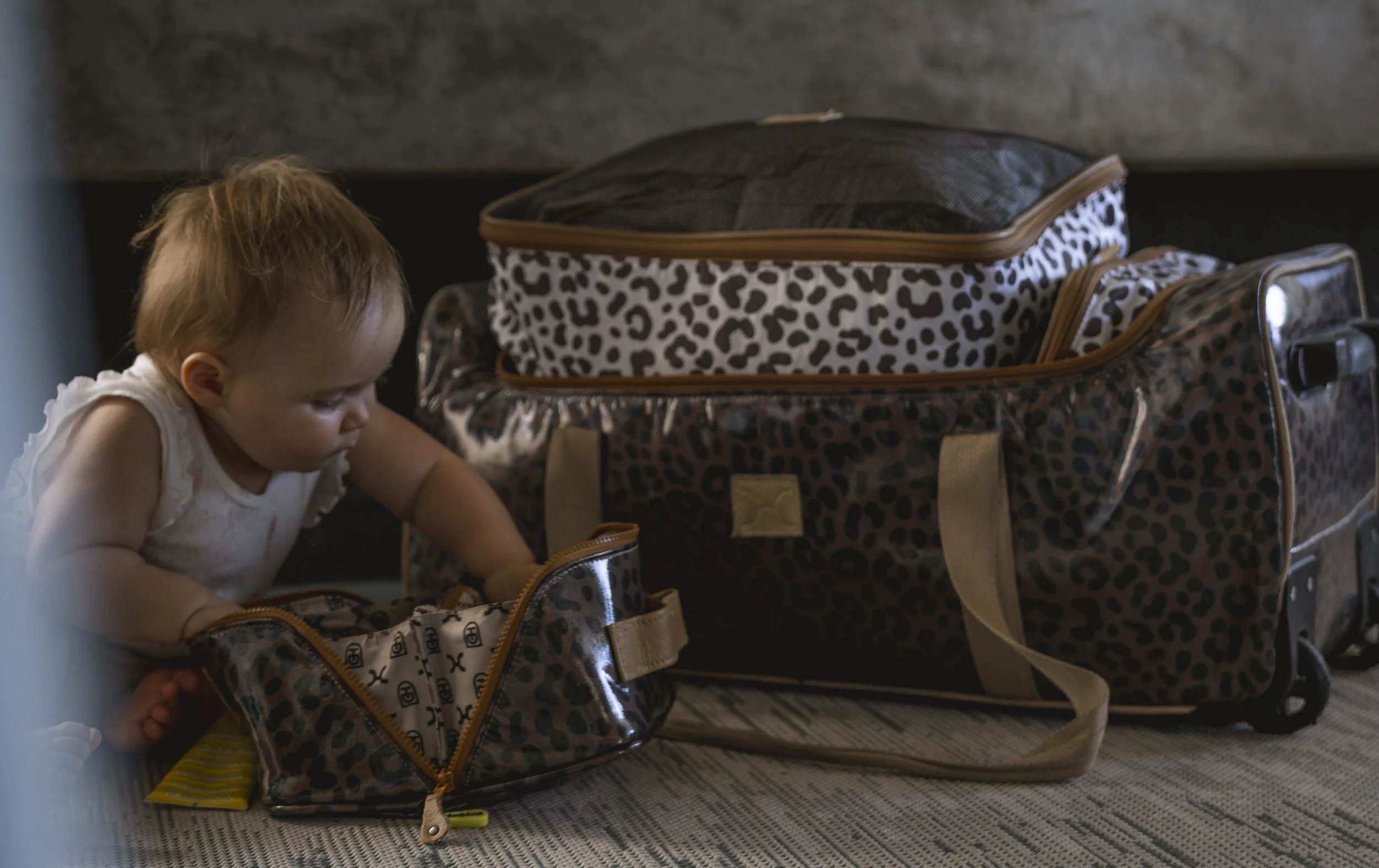
On the shuttle flights we book, each passenger gets one checked bag of up to twenty kilos, plus a carry-on of up to five. The carry-on is separate. It doesn't come out of your twenty, and that's the bit most parents get wrong and then pack short.
Your baby gets an allowance too. Infants, from birth up to their second birthday, are permitted one checked bag of up to ten kilos. That's ten kilos of nappies that don't have to fit into yours.
Soft-sided bags, please. A duffel with one flat side is ideal. If you're travelling with a hard shell it can't exceed forty centimetres wide, thirty high and sixty long.
If your bag is over the limit, it doesn't get loaded. Not charged, not squeezed in. Left behind. Any excess needs to be pre-booked well before you fly, and we'll arrange that for you if you need it.
Nothing oversized travels on your lap either. Loose items in a small cabin are a safety issue, so don't plan around holding something. Your kid will be the only lap-luggage you’ll be paying attention to anyways.
One last thing that catches parents out. No aerosols. Compressed gases are on the forbidden list and you'll be asked about it at check-in, so check your sunscreen and your mozzie spray before they go in the bag. Creams, lotions and roll-ons are fine, and that's what we carry.
Allowances vary between operators and routes. We'll confirm yours in writing before you fly.
Eight Things That Have Never Left Our Bag
These have been a constant from day one. Things shift in and out of the bag as she moves through each age bracket, but these eight have never come out.
Blackout cot cover. The first thing that gets packed, always. Safari rooms are beautiful and they are rarely dark, and a midday nap in a suite is a losing battle without help. Ours is ventilated so there's airflow through it, it packs flat, and it doubles as another layer of mosquito protection over the cot. Check it fits the frame when you arrive.
Her comforter, her dudu. Kids need familiarity that smells like home and their safe space. We pack two of the same in case one gets flung from a game drive. Believe me, it happens.
Compact travel toy. We lug our stacking cups everywhere. They're great for airports, downtime in lodge rooms, outdoors in the sand and even in the bath for a little extra entertainment.
Soft broad-brimmed hat. A lot of game drives are in open or completely roofless vehicles, so sun protection is vital. We carry one in her day bag and a spare in her main bag.
Sunscreen. Age appropriate, for sensitive skin. Lodges do carry sunscreen but rarely for little people.
Water bottle. Her own, with a bendy straw, which keeps her drinking through the day. Most lodges are moving away from single use plastic, which is a good thing and also means the water on your table arrives in glass. Drinking out of glass is not a baby game.
Mini medical pouch. Small, and packed before anything else. What's in ours is further down.
Nappy purse. We refill as we go, but usually carry three at a time with wet wipes and bum cream. Wet wipes are non-negotiable in our world.
Travelling With the Ideal Nappy Bag
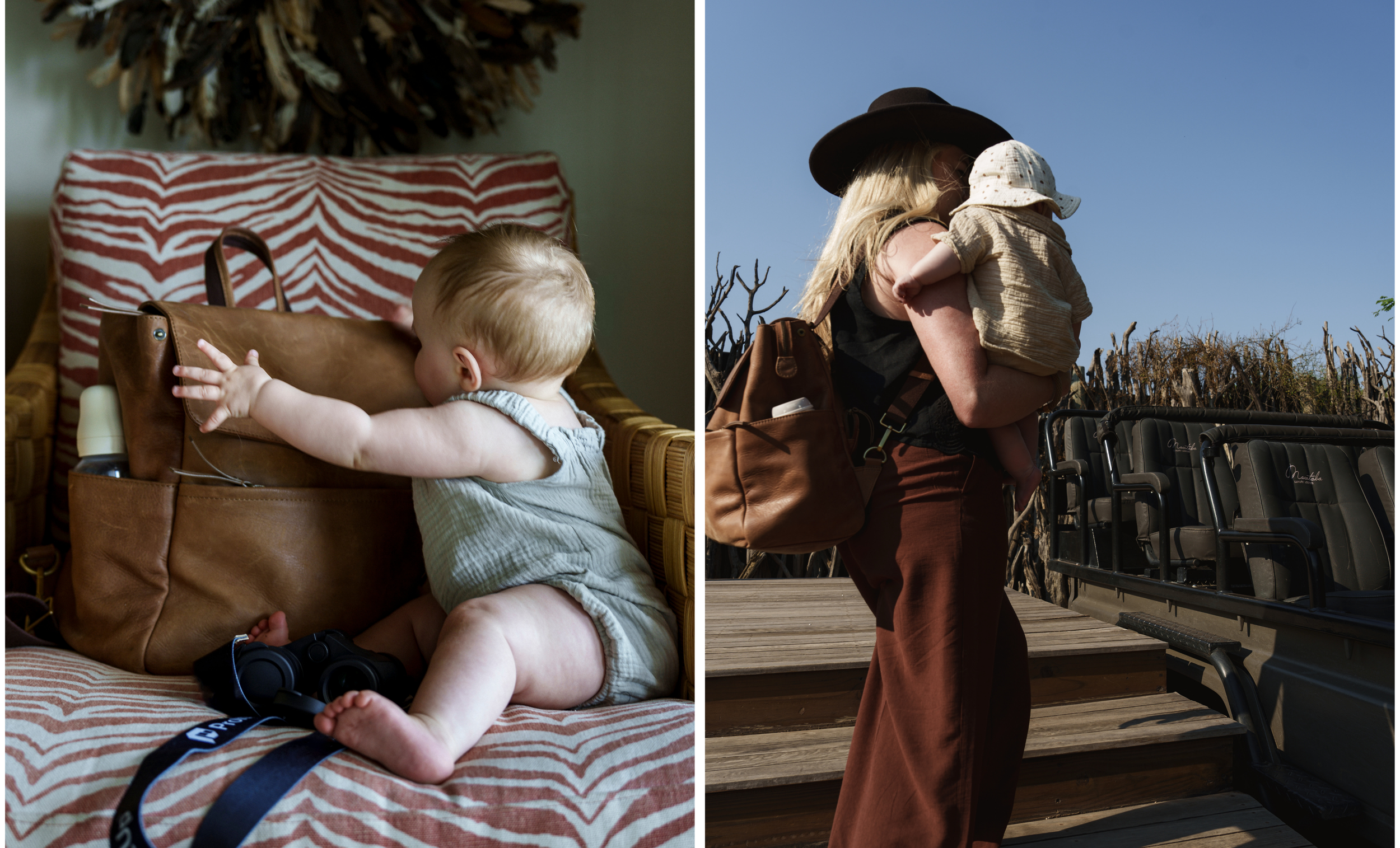
Your nappy bag for safari is everything. It's the item you will use most and the design actually matters. I have been through a few, and in her early years a compartment led bag worked best. As she got older I upgraded to a mum bag that fitted her essentials in.
The ideal nappy bag should be well structured and able to stand up on its own. On a game drive there is very little space to put it down, and the vehicle is moving. We went slim, with a wide easy access zip opening and a lot of interior pockets so you can see everything. The last thing you want to do is dig when your child needs something NOW. Side pockets you can pull a bottle or sunscreen out of quickly, and put back just as quickly. Neutral, hard wearing fabric is good. Ours is leather.
Pack for easy access, not volume. Choose quiet, distraction free items, one comfort toy, and everything should work one-handed.
What Changes as They Grow
We understand that what worked for us may not be what works for you. These are the items that most worked for Bradley and what we feel were the saving grace in how we packed for our trips.
Each list below is complete. Nothing is left out because it appeared in an earlier list, so you can pack straight from the one that matches your child.
Two to six months. It feels like you won't need much, but it still adds up.
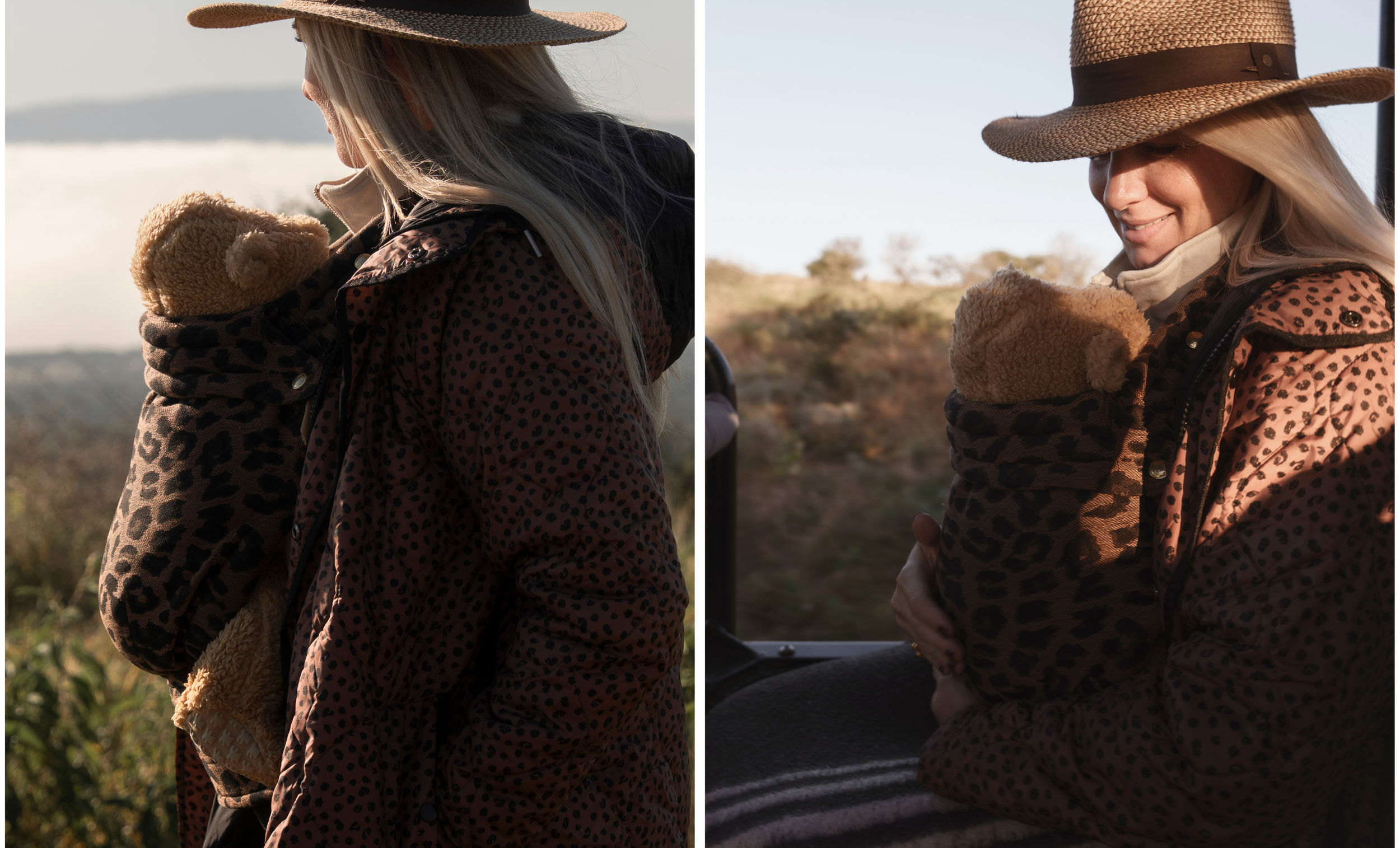
I was a breastfeeding mum, and that should be said right from the start. Up until Bradley was seven months she really only needed me. We carried top up formula, which we divided into ziplock bags by her daily allowance, and that packed far better than a tin. She lived either in her nappy on hot days or in onesies, socks and a beanie in my on-body carrier, and it was the most blissful time in the bush.
Sleep
Blackout cot cover.
Sleep sack. These work for some and not for others, and ours is a godsend. Buy by TOG rating (Thermal Overall Grade) so you can manage night-time temperatures and keep them warm.
Night-time onesies.
Clothing
T-shirts, shorts, long trousers, jumpers, day onesies, a jacket.
Socks, ideally with grippy bits underneath.
Wide-brimmed hat. We travel with two.
Beanie for cold mornings.
Swimming costume.
Muslin blanket. Shade, a ground blanket, and general familiarity.
Muslin burp cloths. We washed and reused three in rotation.
Feeding
Bottles. Three in rotation at this age.
Formula, divided into ziplock bags by daily allowance.
Water bottle with a warmer case, for distilled hot water. This is the emergency formula top up nobody tells you about, and it has saved us more than once.
Pacifiers. Not just one, a few, and ideally with a case because it gets dusty in Africa.
Pacifier clips. They stop the pacifier departing the vehicle.
Bibs. More than you think.
Nappies
Nappies. We aren't reusable nappy parents, and in hindsight that could have saved us a lot of space, but we are who we are. Seven a day, times the number of nights, plus a few. If you do use reusables, tell us at booking and we'll check the laundry situation with the lodge before you fly.
Wet wipes.
Bum cream.
Disposable nappy bags.
Swim nappies. A couple always live in our bag.
Health and kit
Sunscreen, age appropriate for sensitive skin.
Mozzie cream for babies.
Teether toy.
Mini medical pouch, with a thermometer in it. You cannot improvise one at a remote camp.
Travel sized nail clippers or a file. Tiny thing, but small nails scratch small faces and no curio shop stocks them.
Mini bottle of baby body lotion and shampoo.
Her comforter, her dudu.
On-body baby carrier.
What goes in the nappy bag on a drive
Three hours is a long time to be away from anything you might need. This is what comes with us.
Nappy purse with three nappies, wet wipes, bum cream and poo bags.
A bottle preloaded with dry formula, if you're formula feeding.
Water bottle with a warmer case, for distilled hot water.
Muslin, for shade.
Hat on her head.
Spare pacifier, clipped on.
Her dudu.
Body carrier. I wore mine at this age. As we've said, game drives are great sleeping machines.
Teether toy.
Change of clothes, because oopsies happen.
Mini medical kit.
Sunscreen.
Mozzie cream.
Lodges have blankets and hot water bottles on board, so there's no need to carry your own.
What we never packed, and you might
A breast pump. I fed on demand, so I never travelled with one. If you pump, ask us at booking and we'll confirm what storage the lodge can offer before you fly.
Ear defenders for the light aircraft. We've never used them. Bradley has slept through nearly every flight, but plenty of parents prefer them and it's a fair call either way.
Reusable nappies. See above.
As soon as she started solids, life got simpler. Bottles came down to one for night time. Formula stopped taking up half the bag, the burp cloths went, and many pacifiers became two.
Six to twelve months. Big developmental changes, and the packing changes with them.
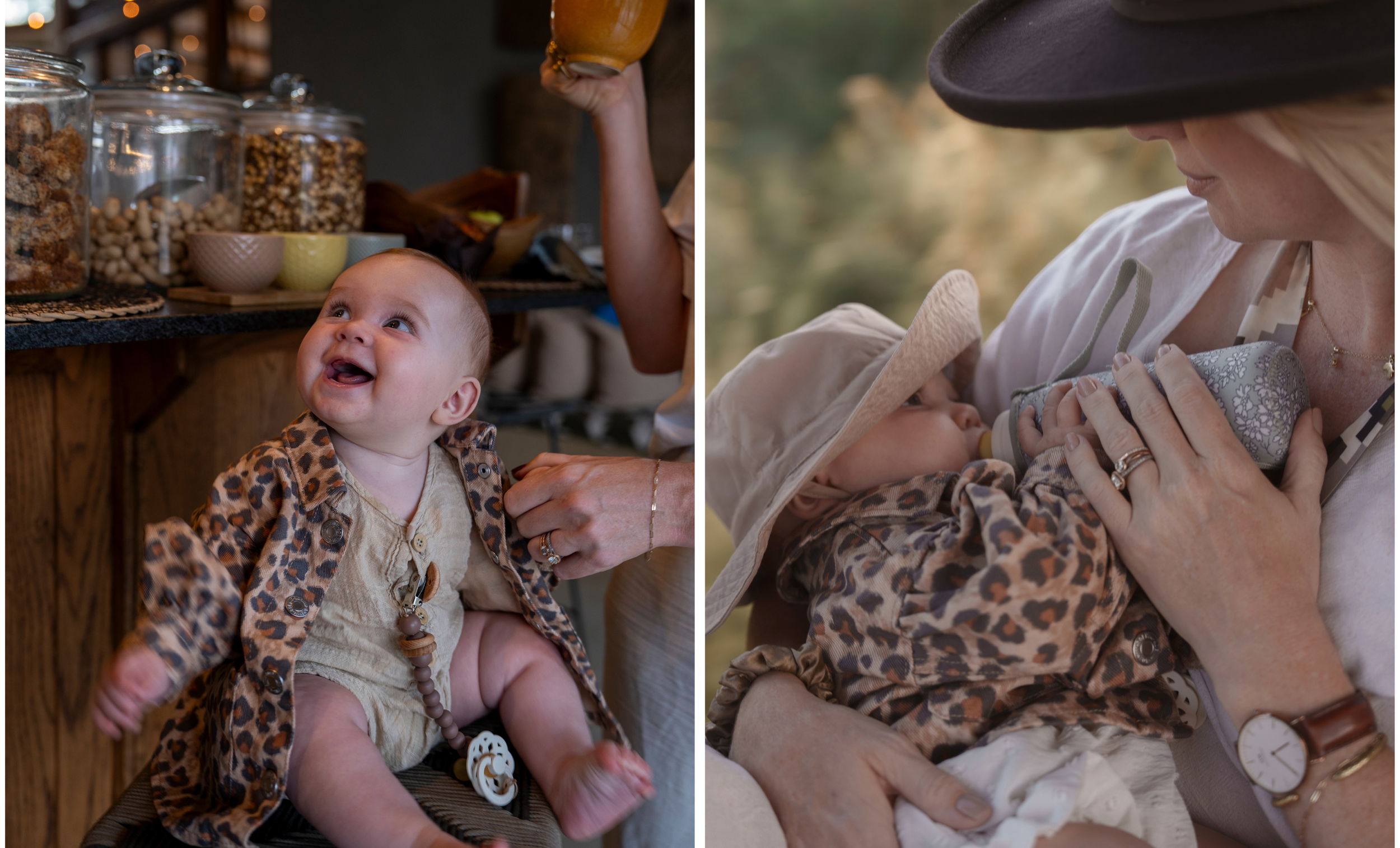
Six to twelve months moves fast, and what she needed at eight months she had no use for at twelve. This list is deliberately comprehensive, so take out what your child has already grown past.
Sleep
Blackout cot cover. This will be with us until she gets her own bed.
Sleep sack. These work for some and not for others, and ours is a godsend. Buy by TOG rating (Thermal Overall Grade) so you can manage night-time temperatures and keep them warm.
Night-time onesies.
Clothing
T-shirts, shorts, long trousers, jumpers, day rompers, a jacket.
Socks, ideally with grippy bits underneath.
Shoes. Velcro straps and little Ugg booties that stay on.
Wide-brimmed hat. We travel with two.
Beanie for cold mornings.
Swimming costume.
Muslin blanket. Shade, a ground blanket, and general familiarity.
Muslin burp cloths. Three in rotation, washed and reused. She stopped needing these around ten months.
Feeding
Bottles. Three in rotation at this age.
Formula, divided into ziplock bags by daily allowance.
Water bottle with a warmer case, for distilled hot water. This is the emergency formula top up nobody tells you about, and it has saved us more than once.
Pacifiers. Not just one, a few, and ideally with a case because it gets dusty in Africa.
Pacifier clips. They stop the pacifier departing the vehicle.
Bibs. More than you think.
Dummy feeder. An absolute godsend for popping fruit into on a game drive, or yoghurt once you start introducing solids.
Silicone cup with a bendy straw for small sips of water. It doubles as a snack cup for the soft fruit you use in the dummy feeder.
Travel sized rubber spoon. We always travel with our own, age appropriate.
Nappies
Nappies. We aren't reusable nappy parents, and in hindsight that could have saved us a lot of space, but we are who we are. Seven a day, times the number of nights, plus a few. If you do use reusables, tell us at booking and we'll check the laundry situation with the lodge before you fly.
Wet wipes.
Bum cream.
Disposable nappy bags.
Swim nappies. A couple always live in our bag.
Health and kit
Sunscreen, age appropriate for sensitive skin.
Mozzie cream for babies.
Teether toy.
Mini medical pouch, with a thermometer in it. You cannot improvise one at a remote camp.
Travel sized nail clippers or a file. Tiny thing, but small nails scratch small faces and no curio shop stocks them.
Mini bottle of baby body lotion and shampoo.
Her comforter, her dudu.
On-body baby carrier. We started leaving this behind at around eight months, once she was happy sitting on our laps and would sleep in the middle seat between us.
Stacking Cups or travel toy.
What goes in the nappy bag on a drive
Three hours is a long time to be away from anything you might need. This is what comes with us.
Nappy purse with three nappies, wet wipes, bum cream and poo bags.
A bottle preloaded with dry formula, if you're formula feeding.
Water bottle with a warmer case, for distilled hot water.
Snack cup with a straw.
Dummy feeder.
Rubber spoon.
Muslin, for shade.
Hat on her head.
Spare pacifier, clipped on.
Her dudu.
Body carrier, until around eight months.
Teether toy.
Change of clothes, because oopsies happen.
Mini medical kit.
Sunscreen.
Mozzie cream.
Lodges have blankets and hot water bottles on board, so there's no need to carry your own.
What we never packed, and you might
A breast pump. I fed on demand, so I never travelled with one. If you pump, ask us at booking and we'll confirm what storage the lodge can offer before you fly.
Ear defenders for the light aircraft. We've never used them. Bradley has slept through nearly every flight, but plenty of parents prefer them and it's a fair call either way.
Reusable nappies. See above.
By ten months the carrier had stopped coming with us, we rarely needed the burp cloths and she was eating most of what we ate at breakfast now. A few things off the list, and onto the next adventure…
Twelve to eighteen months. Our easiest age to travel.
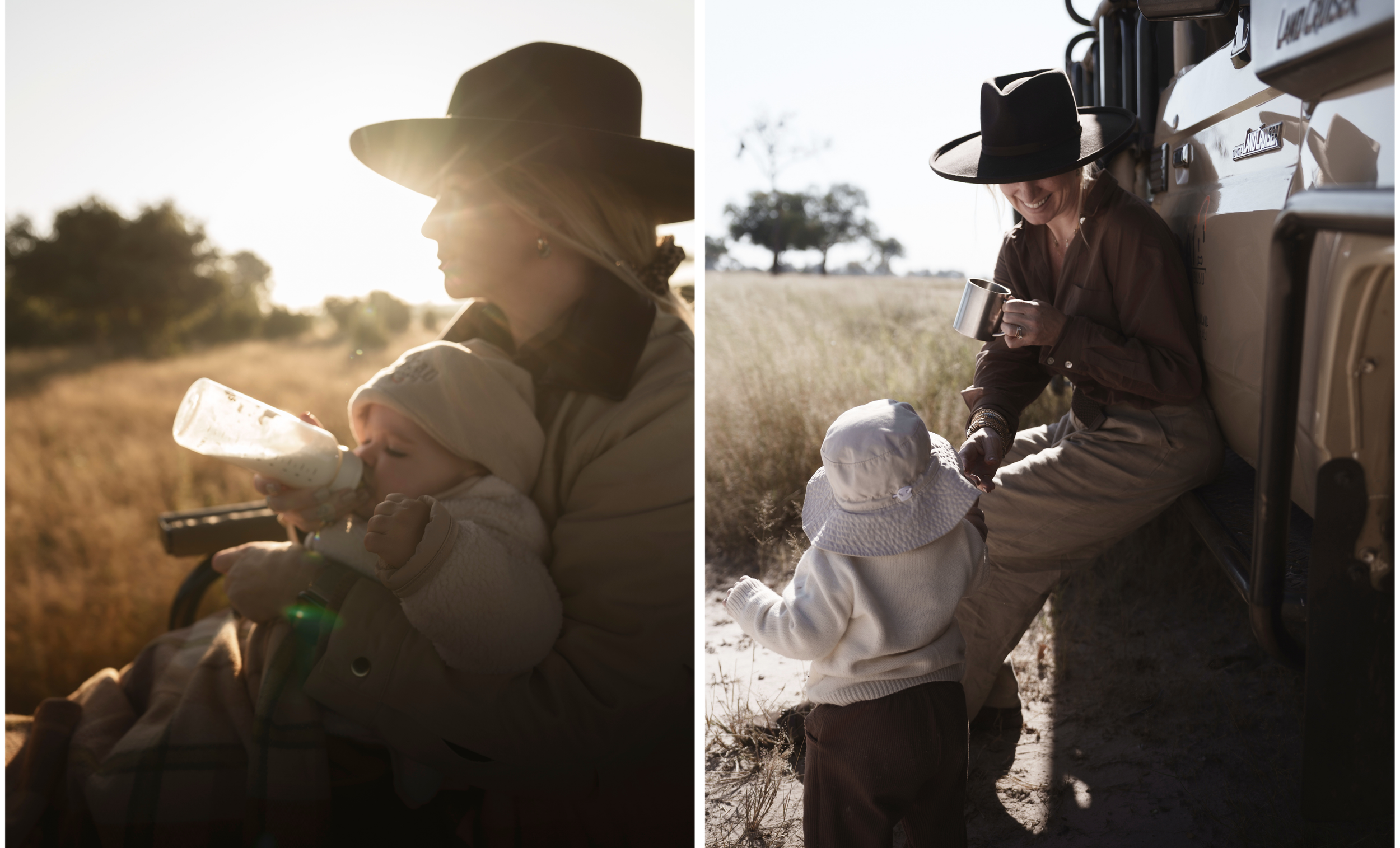
Travelling became so much simpler at this age. Her needs changed, she could use most things in the lodge suite, she ate solids with us at breakfast, and mum got her bag back. Kind of. We also started worrying less about forgetting things, because we could improvise at the lodge. Honestly, this is our best age to travel with a child.
Sleep
Blackout cot cover. This will be with us until she gets her own bed.
Sleep sack. These work for some and not for others, and ours is a godsend. Buy by TOG rating (Thermal Overall Grade) so you can manage night-time temperatures and keep them warm.
Night-time onesies.
Clothing
T-shirts, shorts, long trousers, jumpers, day rompers, a jacket.
Socks.
Shoes. Velcro strap trainers, little Ugg booties that stay on, and sandals. Three pairs, one for each part of your day.
Wide-brimmed hat. We travel with two.
Beanie for cold mornings.
Swimming costume.
Muslin blanket. Shade, a ground blanket, and general familiarity.
Feeding
Bottle. One was enough once she moved to a night-time feed only.
Formula, divided into ziplock bags by daily allowance.
Water bottle.
Pacifiers. Not just one, a few, and ideally with a case because it gets dusty in Africa.
Snack cup or a small tupperware for emergency snacking.
Nappies
Nappies. We aren't reusable nappy parents, and in hindsight that could have saved us a lot of space, but we are who we are. Seven a day, times the number of nights, plus a few. If you do use reusables, tell us at booking and we'll check the laundry situation with the lodge before you fly.
Wet wipes.
Bum cream.
Disposable nappy bags.
Swim nappies. A couple always live in our bag.
Health and kit
Sunscreen, age appropriate for sensitive skin.
Mozzie cream for babies.
Teether toy.
Travel sized nail clippers or a file.
Mini medical pouch, with a thermometer in it. You cannot improvise one at a remote camp.
Mini bottle of baby body lotion and shampoo.
Her comforter, her dudu.
Stacking cups or travel toy.
What goes in the nappy bag on a drive
At this age I left the nappy bag in the suite and only took my own bag on drives. She needed less, and what she did need took up very little space in my canvas tote.
Nappy purse with three nappies, wet wipes, bum cream and poo bags.
Water bottle.
Snack cup.
Hat on her head.
Spare pacifier. Just in case.
Her dudu. Always.
Teether toy.
Spare T-shirt.
Mini medical kit, which doubled as my vanity bag.
Sunscreen.
Mozzie cream.
Lodges have blankets and hot water bottles on board, so there's no need to carry your own.
What we never packed, and you might
A breast pump, if you're still breastfeeding at this age. I fed on demand and she stopped at seven months, so I never travelled with one. If you pump, ask us at booking and we'll confirm what storage the lodge can offer before you fly.
Ear defenders for the light aircraft. We've never used them, but plenty of parents prefer them and it's a fair call either way.
Reusable nappies. See above.
This was the trip where the nappy bag ended up staying in the suite and my own tote did the job instead. The first time in a year that I walked to the vehicle carrying one bag rather than three, I am all for this age and travel!
Eighteen to twenty-four months. A mini adult starts attending game drives.
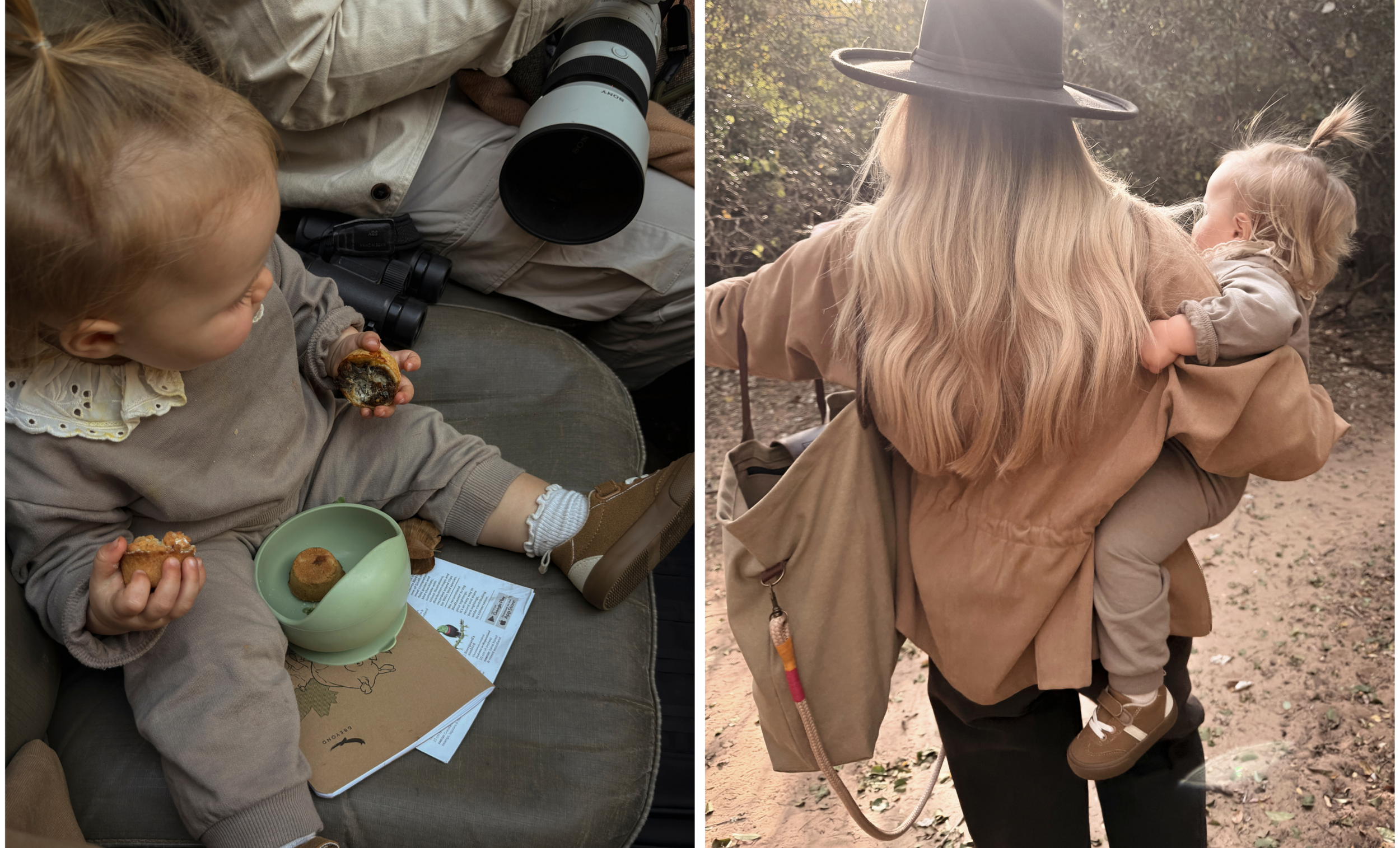
The interaction at this age makes life so much fun. There are lodge besties to look after your kids, kids clubs in the afternoon, and a lot more dirty clothes. Luckily most of the real schlep of carrying baby things has come to an end, and what you don't have, the lodge does. You're in moving territory now, so shoes are vital.
Sleep
Blackout cot cover. This will be with us until she gets her own bed.
Sleep sack, or whatever they're most comfortable sleeping in at this age.
Night-time onesies or pyjamas.
Clothing
T-shirts, shorts, long trousers, jumpers, day rompers, a jacket.
Socks.
Shoes. Pack backups. Busy feet require options.
Wide-brimmed hat. We travel with two.
Beanie for cold mornings.
Swimming costume.
Feeding
Bottle, if they're still having a night-time feed.
Formula, divided into ziplock bags by daily allowance.
Water bottle.
Pacifiers, if they're still using them. And never just one, a few, ideally with a case because it gets dusty in Africa.
Snack cup or a small tupperware for emergency snacking.
Nappies
Nappies. We aren't reusable nappy parents, and in hindsight that could have saved us a lot of space, but we are who we are. However many you go through a day, times the number of nights, plus a few. If you do use reusables, tell us at booking and we'll check the laundry situation with the lodge before you fly.
Wet wipes.
Bum cream.
Disposable nappy bags.
Swim nappies. Not vital, but we always carry a few.
Health and kit
Sunscreen, age appropriate for sensitive skin.
Mozzie cream, kid friendly.
Travel sized nail clippers or a file.
Mini medical pouch, with a thermometer in it.
Mini bottle of baby body lotion and shampoo.
Her comforter, her dudu.
Stacking Cups still come along for entertainment.
What goes in the nappy bag on a drive
I started giving her her own little game drive bag at this age. She needed less, but she always wanted her own stuff. So here we are.
Nappy purse with three nappies, wet wipes, bum cream and poo bags.
Water bottle.
Snack cup.
Hat on her head.
Spare pacifier, kept in my bag rather than hers so she doesn't rely on it.
Her dudu. Always.
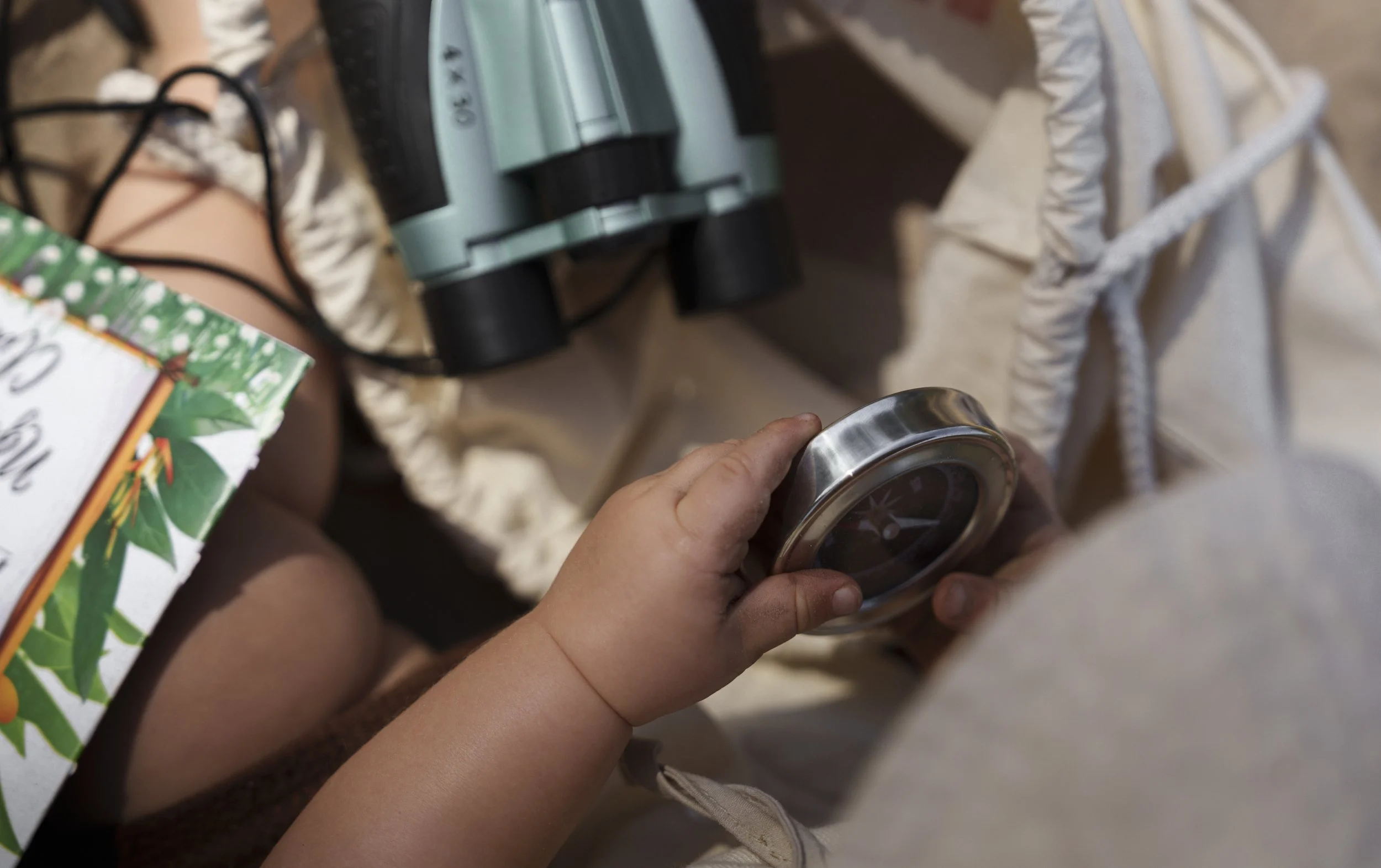
A small pair of binoculars.
A little book of African animals, for when she gets bored.
Spare clothes.
Mini medical kit, which doubled as my vanity bag.
Sunscreen.
Mozzie cream.
Lodges have blankets and hot water bottles on board, so there's no need to carry your own.
What we never packed, and you might
Ear defenders for the light aircraft. We've never used them, but plenty of parents prefer them and it's a fair call either way.
Reusable nappies. See above.
The bag she wants to carry is mostly for show, and mum is still very much the pack pony. But the real change at this age isn't what's in it. It's that she needs less from it. The binoculars get used because someone put them in her hands and told her what to look for. A guide who knows how to hold a small child's attention does more than anything I could pack, and by this age that matters more than the kit.
Carrying, Not Pushing
Travel prams are life, especially once your tot gets over a certain weight. Being able to pop out your traveller, hoist in the baby and away you go. On safari, we unfortunately say goodbye to the pram and go back to the old-fashioned way of the hip carry.
Camp paths are not built for prams. Sand, gravel, uneven surfaces, and we will never be able to tell you in advance whether yours will handle them. Not ideal for that pram life.
Getting it there is the other problem. With twenty kilos of checked luggage per person, a pram is weight you'd rather spend elsewhere. Most of the operators we book have storage at their base, usually complimentary if you're booked on a return, which makes it easy to offload anything you won't need at the lodge.
Under twelve months I used an on-body carrier. After that, a one-shoulder hip carrier. And now that she's a little madam with shoes on her feet and places to go, we rarely use any form of transport unless we need to distract her from another stick she's bonded with.
On the vehicle
How your child travels on the vehicle will depend on the lodge and its own safety policy. Bradley has travelled in a carrier, beside us and on our laps depending on her age and the property. Some lodges can provide car seats, which we'll confirm with you before arrival.
Once they're walking
Most camps are unfenced. There's usually an elephant wire around the perimeter, but that's there to stop elephants taking down water pipes and trees rather than to keep anything out. Other wildlife moves through camp freely.
It's a parent's responsibility to know where your child is at all times and to keep them close. Walking without an escort is forbidden from evening through to early morning. Children should stay with an adult and on designated pathways at all times. Each lodge has its own safety protocols, and those always take priority.
The Medicine Bag
This is our emergency zip up case, with a little of everything in it. We've only had to use a few things in there, less than a handful of times, but we are always glad we have it. Lodges do carry medical supplies, and we still never assume. Having our own kit on us at all times is what relaxes us.
I am a qualified traveller and parent, not a medical professional. What follows is what our family carries, and it isn't a recommendation for yours. Speak to your doctor before you fly and let them tell you what to carry based on your child's age and history. Fill any chronic prescriptions in your country of origin rather than hoping to find them at your destination. The same applies to malaria prophylaxis, which we cover properly here.
An example of what's in our medi-bag: antihistamine cream and tablets, because not every mosquito carries malaria and sensitive little skin still reacts. Tummy medicine in both tablet and syrup form. A syringe. BurnShield pouches. Bactroban, which has always been our go-to for infected little scrapes. Anti-nausea medication. Paracetamol. Lip balm. Age-appropriate eye drops. Saline nasal spray for the dry air. A chest rub. Gastro medicine. Rehydrate sachets.
You know your child, and we would always rather be over prepared in the bush.
Throughout our time on safari I always had people say, "when she gets to X age it'll be tough to do this with her." Then that age came and went and we carried on, but so did the comments. What we've learnt is that every age has its moments. And the only thing that really makes a difference is being prepared.
FAQ
What do you pack for a baby on safari?
Less than you think, because the lodges we book carry the bulky things. A cot made up with linen, a mosquito net, a high chair and daily laundry are all confirmed before you arrive, which takes the camp cot and half the wardrobe out of your bag. What you carry is what only you can bring. A blackout cot cover, their comforter, bottles and formula, nappies for the full stay, sun and insect protection, and a small medical pouch. Full lists by age are above.
What do you pack for a toddler on safari?
By eighteen months the bag has shrunk considerably. Shoes become the thing you pack backups of, because they are walking now and camp is sand and gravel. You still need nappies for the full stay, sun and insect protection, a water bottle and a snack cup, and their comforter. What changes most is entertainment. A small pair of binoculars and a book of African animals do more on a drive than anything else we carry.
Do safari lodges provide cots and high chairs?
The ones we book do, and we confirm it before you arrive rather than hope. A fully made up cot with fresh linen, extra blankets and a mosquito net, plus a high chair at meal times. Not every property is set up this way, which is exactly why we ask.
Can you take a pushchair on safari?
In practice, no. Camp paths are sand, gravel and uneven ground, and we can never tell you in advance whether yours will handle them. Light aircraft weight limits make it an expensive thing to carry, and most of the operators we use have storage at their base where bulkier items can be left, usually free if you're booked on a return. A carrier under twelve months and a hip carrier after that is what has worked for us.
Do safari lodges do laundry?
Daily laundry is standard at the lodges we book, and it halves what you need to pack. Some properties include it, some charge for it, and we'll tell you which before you book.
How many nappies should I pack for safari?
Work on however many your child goes through in a day, times the number of nights, plus a few. There is no shop at camp, so this is the one item where running out is a real problem.
What is the luggage allowance for safari flights?
On the shuttle flights we book, one checked bag of up to twenty kilos per person, plus a carry-on of up to five. The carry-on is separate and doesn't come out of the twenty. Infants under two get their own checked bag of up to ten kilos. Soft-sided is preferred, and anything over the limit doesn't get loaded, so excess has to be pre-booked. Allowances vary by operator and route, and we'll confirm yours in writing before you fly.
Written by Jemma Park
Founder of House of Wild, qualified safari guide, photographer and mother. Having travelled extensively across Africa both professionally and now as a parent, she specialises in designing luxury safaris for families with young children.
